Never does a war bring peace
A turning point for the region
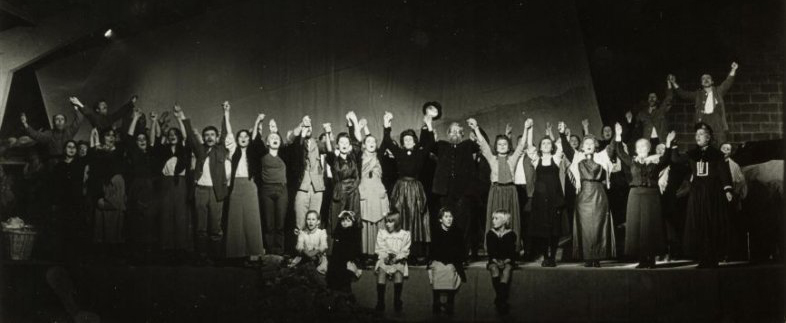
When Jules Lepla told us "his" 11 November 1918, we saw it happening right before our eyes. We thought of a play.
Inspired by the testimonies of men and women who lived through the Great War, Marieke Demeester, with the help of Stefaan Dehollander and Jan Hardeman, wrote the community play NOOIT BRENGT EEN OORLOG VREDE (Never Does a War Bring Peace). 70 amateurs, led by professionals (direction: François Beukelaers, Brussels – choreography: Lea Daan, Antwerp – songs and singing: Wannes Van de Velde, Antwerp), rehearsed from April to November 1978. Gerard Alsteens (GAL) drew the poster.
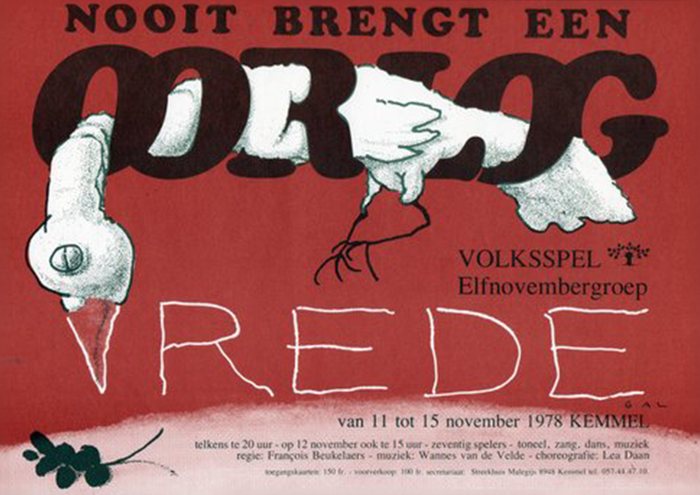
The play was performed in Kemmel in a warehouse that volunteers had converted into a theatre with 800 seats (with the help of Circus Wiener, which supplied benches and a heating installation). First performance: 11 November 1978. The "front-line theatre" was sold out six times.
Two major peace organisations, the "Overlegcentrum voor de Vrede" (Flanders) and "Paix et Développement" (Wallonia), invited the 11 November Group to perform in Brussels, at the Palais des Beaux-Arts (now Bozar), in January 1979. It was a great success. For the partly French-speaking audience we provided a summary in French and sang the closing song in French and Dutch.
During the following theatre season the group performed the play in Antwerp, Ghent, Hasselt, Ostend, Roeselare, Turnhout and again in Brussels. In all, 19 performances for 16,000 spectators. Dozens of articles appeared in the press at home and abroad (the group archive holds 88 press cuttings in 4 languages).
The French theatre magazine "Théâtre Public" (Paris) wrote "L'Événement théâtral de l'année" (the theatrical event of the year). At the UNESCO theatre conference in Vienna in 1979 a lecture was given on this community play. In 1980 the group received the Van Peene-Miry theatre prize.
People of all ages were gripped by the misery, the fear and also the small joys of men and women like themselves. In these men and women of '14–'18 they recognised themselves.
Scene 1 – The armistice (Jules Lepla)
In the community play, Jules Lepla's story became the following scene:
Suddenly church bells, ships' sirens, rockets, cries, shouts. In the middle of the stage stand 5 beds, with the invalids we have seen earlier in them. We live through the end of the war, somewhere under a tent, where five wounded soldiers react to the armistice.
One: What's that?
Two: A fair.
Three: You fool, it's over!
Four: Over…
Two: What?
Three: Come on, men, champagne, champagne!
One: Is it true? Is it really true? Men, we're still alive! We can go home again! Home!
Three: I don't feel any pain any more! (jumps out of his bed – a nurse tries to stop him but doesn't manage).
Five: begins to weep softly, and
Four: to curse. You don't feel any pain any more? I do. Now our misery is only beginning. Home, you say? Yes, without legs. No longer a soldier, no hero, but a wretch for the rest of my days. Can you see me sitting in a wheelchair? And him (points to five), should he be glad it's over?
One and Three fall silent for a moment, but still cannot completely contain their wild joy.
Two: Is it really over? Goddammit, to be lying here instead of being there! I'd have shot a few more of them dead!
Four: Shut up…
Two: And that they give up now! We were winning! Fools! Cowards!
Four: Shut up!
Two: We should have chased them right into their own nest and finished them all off there! And I can't be there!
Four: Shut up, I say! Hasn't it lasted long enough…
Three: I still can't believe it's over.
Scene 2 – The street singer (Marie Beck)
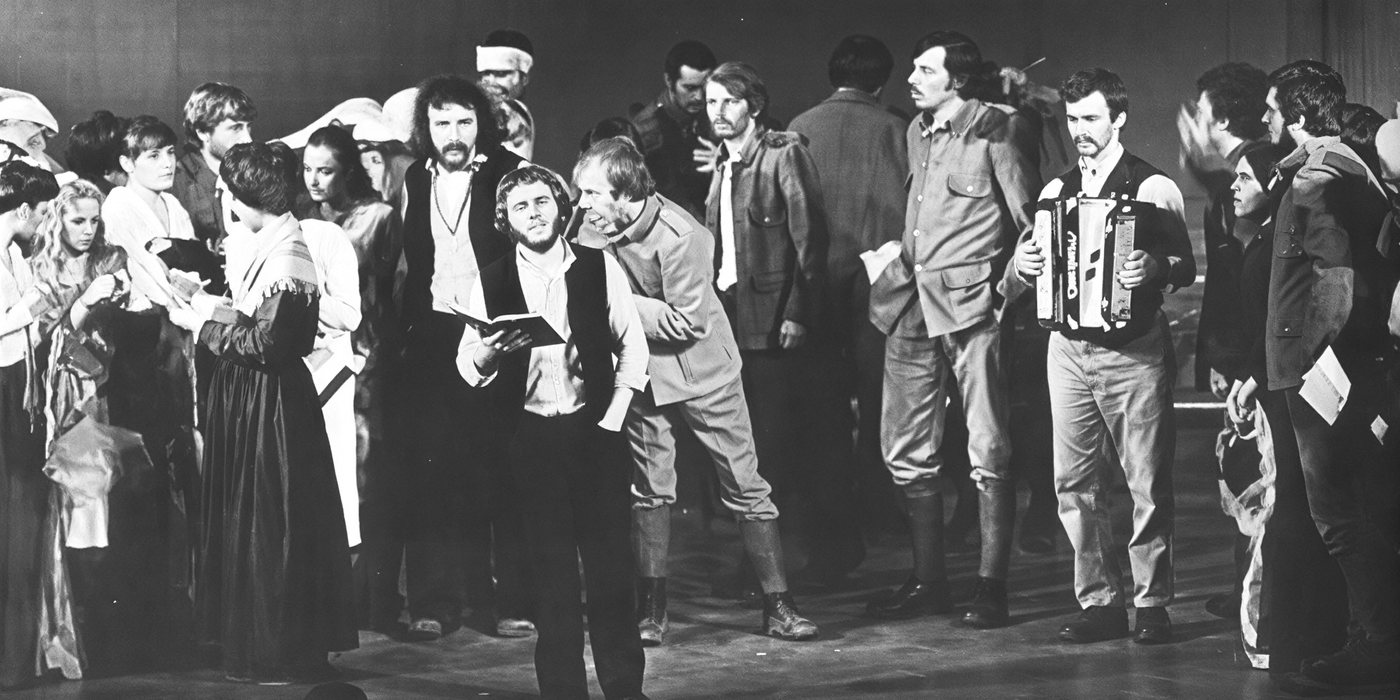
Marie Beck also told us about her eleventh of November in the market at Lisieux. Material right away for a scene with a street singer.
Scene 3 – The barrel of Malaga (Marie Beck)
Many elderly people remember the big and small "war trade". What Marie Beck experienced with a large barrel of Malaga was brought to life in a very lively "market scene". Amid loud jeering, shrieking and shouting, a big barrel of Malaga is rolled onto the stage, children climb on it, the soldiers leave the landlady standing.
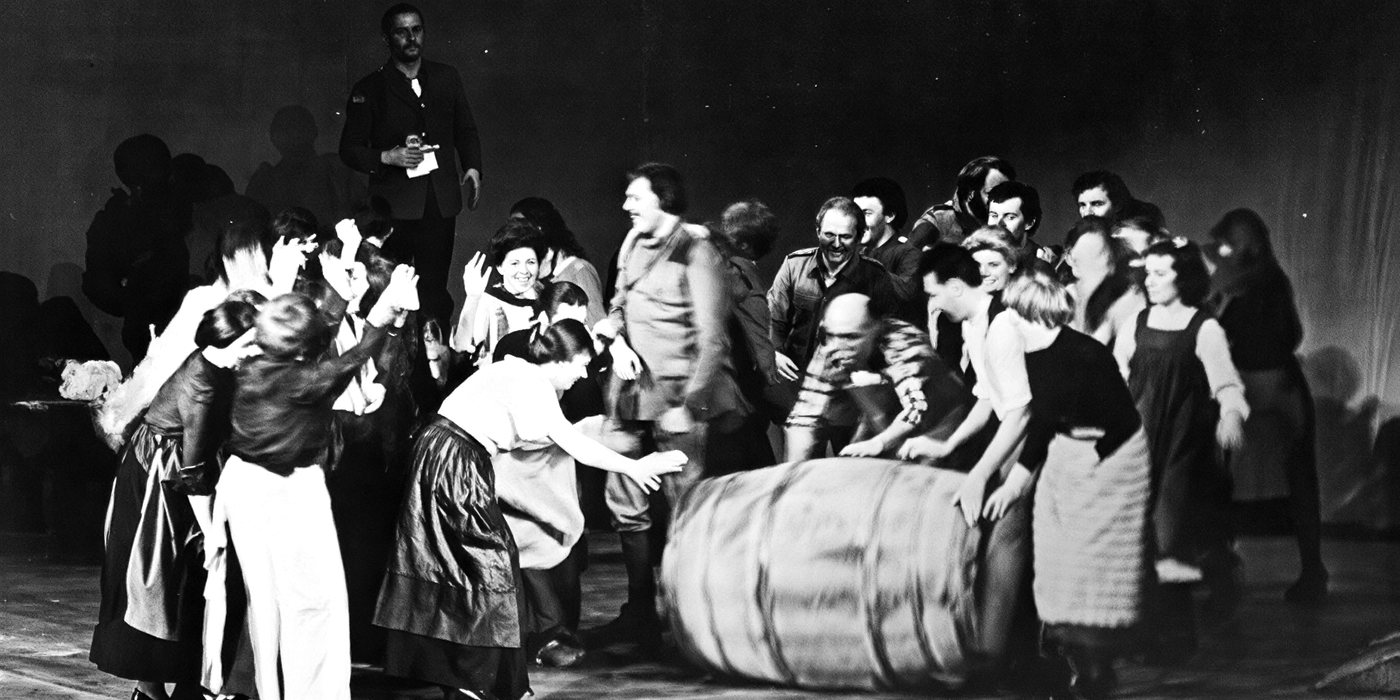
Everyone around the barrel began to sing:
(Wannes Van de Velde wrote this new text to a melody from French Flanders)
Merchant, be glad,
it's in wartime
that our trade flourishes.
Leave the dove of peace at home.
If it were up to the pacifists,
we'd be poorer than a louse.
A girl pours wine, lace is traded. Souvenirs (including decorated shell casings) are sold. Most of the townspeople are beginning to have quite a bit of money. A photographer sets up his apparatus. Children walk around with cakes.
Fill your pockets now,
the bread is baked
for the bad times.
Whoever understands business
need not fear the war
but seizes his chance now.
A few prostitutes are swarming with soldiers, a man with a bicycle carrying a sack of potatoes and a sack of flour is brought in, again much money changes hands. A few soldiers, led by a girl, go to the photographer. The soldiers hum "Pack up your troubles…" but sing "Smile, smile, smile" at every photo.
A woman comes onto the stage with much commotion, her husband behind her.
Woman: To be able to buy a barrel of 1,000 litres of Malaga, Jeanne, 1,000 litres, that's a good 20,000 little drops, in that barrel there is gold and happiness, boys, what a war!
Man: Gusta, you're going mad, 1,000 litres of Malaga, do you know what that is? What are you going to do with it when peace comes!
Everyone watches, the photographer takes the last photos. Everyone runs back to the barrel of Malaga.
Pay no heed to the wounds,
trade is no sin
while the battle rages.
In the heat of the fight
we run at full speed.
Long live, long live wartime.
Scene 4 – The wedding in Reninghelst
An apparently unimportant little entry in the war diary of Pastor Achiel Van Wallegeghem.
19 October 1917, Tuesday – Today a wedding took place here at Reninghelst between an English soldier and a girl of the parish. Many onlookers, civilians and soldiers. The latter seemed to be having great fun with their mate, who looked embarrassed and hurried to the carriage. The soldiers had written on it "We are married to day in Reninghelst". And so the couple left for Poperinghe. A few days later the young wife shipped to England to comply with the English army law that wants soldiers' wives in England."
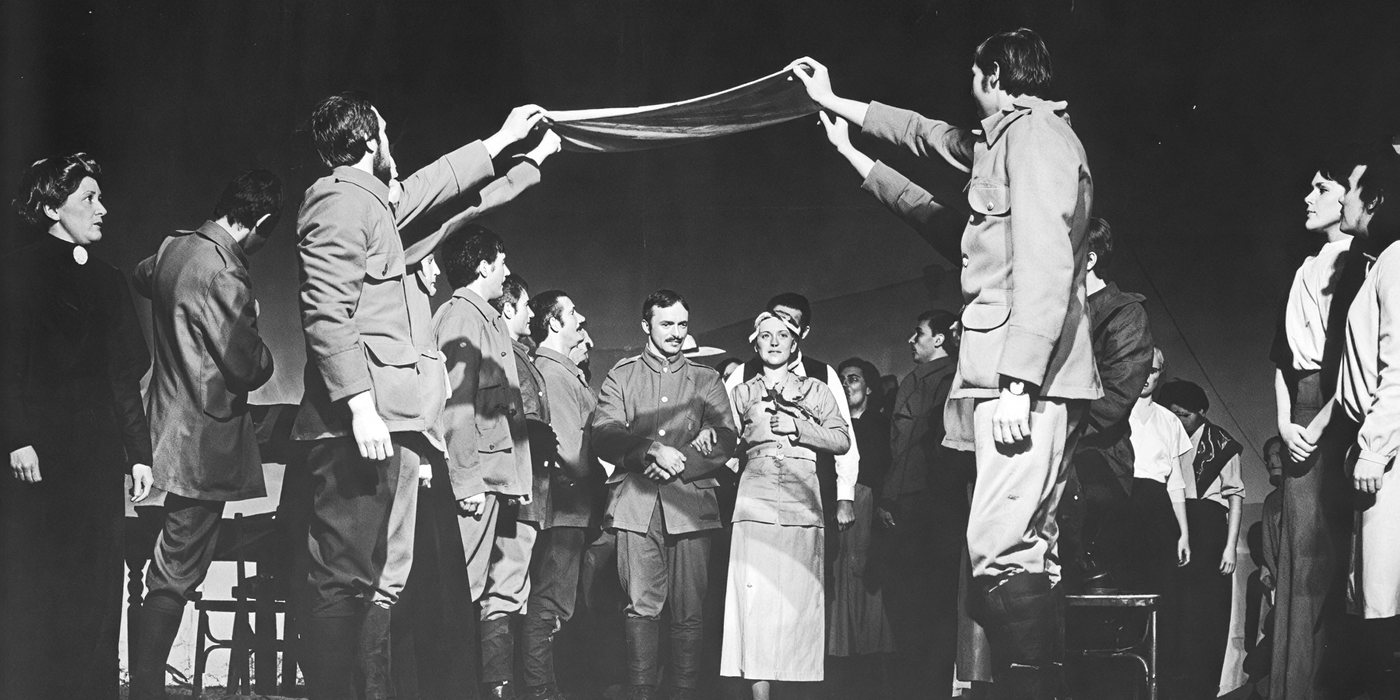
So ordinary, so everyday, and therefore probably so moving. A little imagination, the right words, a song, and all the dramatic tension of this "wedding scene" is there.
The wedding procession enters. The whole group sings the "Vivat". Four soldiers hold a tablecloth as a canopy over the heads of the bride and groom.
Vivat, vivat semper
semper in aeternum
Long live, long live
long live the bride,
and we wish her a good life
in peace and quiet
After the Vivat, cynical in these circumstances, the bride sings her song.
I am carrying a child now, my own child,
who makes me forget the war,
but if it is born in war,
whether that is good, who can know that yet.
They said, they said: my love was far too young
to enter into marriage;
but to kill he was old enough,
that no one ever disputed.
My child, my child, whoever lives in wartime
cannot enjoy life,
and if I kill you, I am a murderess,
but your father has to shed blood.
We chose a few scenes from the community play that are inspired by testimonies from the book.
Jules Lepla
Scene
In the night, the colonel-doctor, half mad, flings the door open and says "Boys, courage, tomorrow at eleven, not another shot will be fired".
That was some scene in the hospital.
There were some who began to sing. I was one of them, out of joy. There were some who began to curse and carry on. God damn it, I'd like to be at the front, I'd like to shoot a few more dead.
There were poor devils there, one badly gassed and with a leg shot off. He was dying.
There were poor devils there who began to cry, with arms and legs gone. Yes, the war will be over and I am unhappy for the rest of my days.
That was a sad scene. Nobody slept a wink the whole night.
Marie Beck
You can imagine.
People were already gathering in the market. Crowds of them. It was a real fair. You can imagine. Four years of misery. Over! French and many Belgian refugees. The cafés were more than full. A fine sou was earned that day. And singing! There was one who got up on a crate. He had his accordion with him. "La Guerre est finie" he sang. Lovely meadow. "La Guerre est finie – ie – ie". I thought, the lad doesn't know what he's singing about. Marie has seen the war. It's misery. There is nothing beautiful about it. "Nos héros…" Our heroes. Yes, there were heroes, people who did what they had to and had courage and were cold and hungry. But not heroes like in his little song. Nobody takes risks for glory. "Nos héros…" Heroes. People who, like all people, were frightened by such terrible things. In no time, everyone was singing along. Many were drunk that day. We also had our own little fair, among ourselves. Belgian refugees, family. For once a proper meal. In the evening a dispatch came. The fair was over. Hector Fever had been shot, five minutes before eleven, came out of his trench too quickly. You can imagine, the brother of Daniël who was married to our Germaine.
Marie Beck
Malaga.
From mid-'16 it was our Mess-room. They had the kitchen and the bakehouse and the room at the end and two rooms upstairs. The orderlies and three or four officers with a red band on their caps, big men, from the état-major. The inn was allowed to be open from eleven to one and from six to eight. Sometimes it was hard to get drink. It happened once that our English were smuggling the goods from France for us, English stout or English beer. He was a refugee from Wijtschate or from Messines, who delivered to us, who did trade at the border at Loker, I think. Malaga. Liqueur. The last Malaga we had was a barrel of 1,100 francs. That was a lot of money. That man came and said, look, he says to mother, I still have a big barrel for eleven hundred francs. It's the last. No more is coming in. If you want it, I'll keep it ready; if you don't, I'll draw it off into casks and sell it that way. It was a terribly big barrel, of a thousand litres. Well, says mother, bring it. Now, he delivers it on a Sunday. I came home from first mass and he was there. Father was grumbling. Mother was in bed, she couldn't get up because of a bad leg. That fellow waited until I came home. Father said, what a risk, such money, and what are you going to do with it, this war isn't going to last... It's mother who ordered it, I say, Father, you grumble there, but it's still me who sees to it and sells it. You only have to bend the money and make it even. You only have to do that and you still grumble!